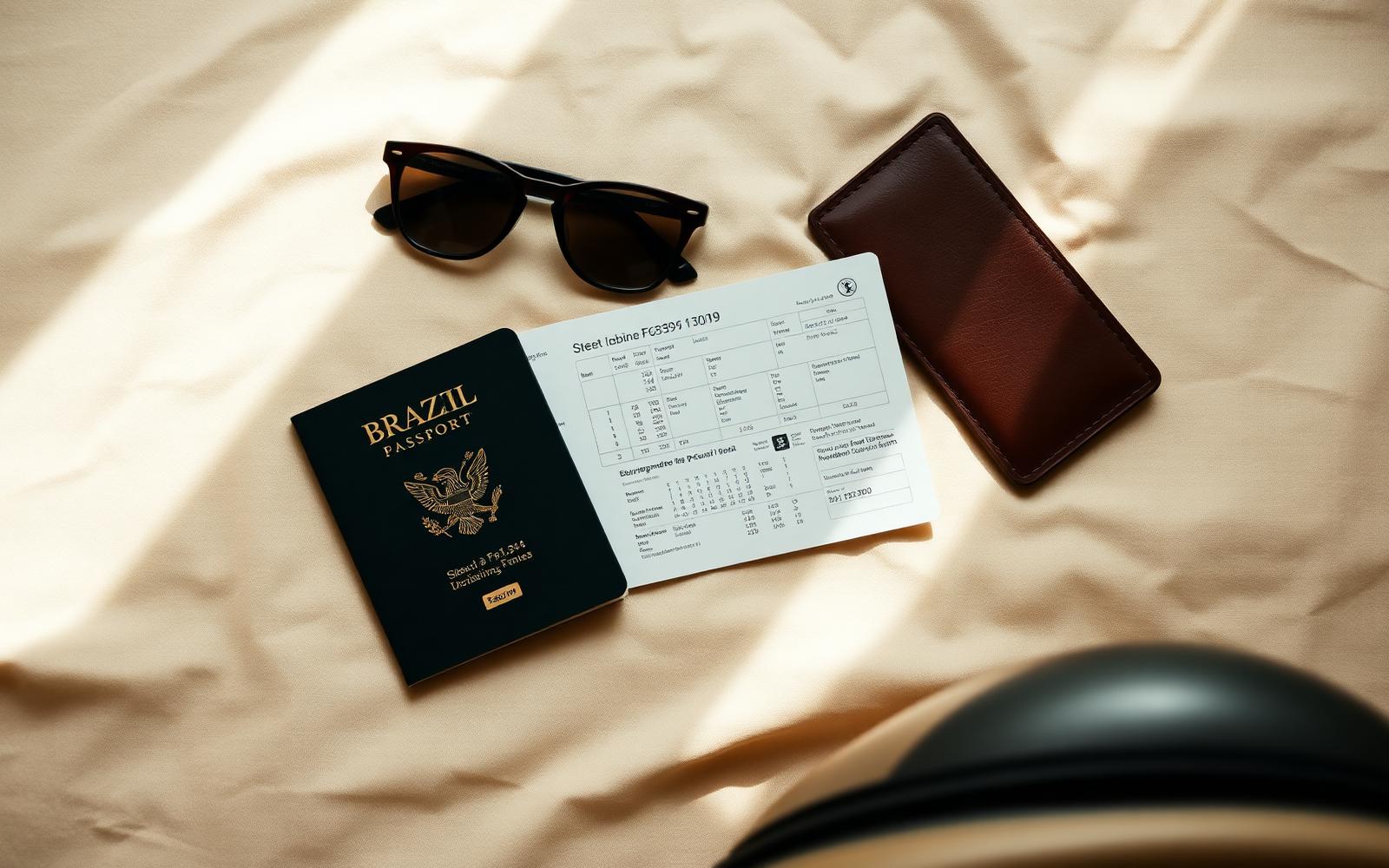
Most of the stress of a first international trip doesn't happen abroad. It happens in the weeks before departure, when you discover you're missing a document, the airport lines are longer than you imagined, or there's no time left to get to the gate. The good news: almost all of this can be anticipated and sorted out in advance.
This guide organizes your first trip as it really is: a timeline of decisions. And one of the most underestimated decisions starts with a simple question: how much is your time before your flight worth? Answer it early, and you can board without the stress. Leave it until the day of your flight, and you'll be rushing.
Start with your documents: the timeline depends on what you need to do
Documents are the one thing you can't sort out at the airport, and preparation times vary widely depending on your situation. Use this timeline as a guide for when to start.
You already have a valid passport and your destination doesn't require a visa: 30 to 45 days in advance is enough time to take care of the rest without rushing (insurance, currency exchange, luggage).
You need to apply for or renew your passport: start 2 to 3 months in advance. Passports are usually issued within a few business days after your appointment, but getting an appointment with the Polícia Federal is the bottleneck and can take weeks during peak season.
Your destination requires a visa (as is the case for the United States): start 3 to 4 months in advance or earlier. The wait for a consular interview can range from weeks to months depending on the location, and it is the most unpredictable part of the process.
The rule is simple: the more your destination depends on a visa or a new passport, the earlier you should start. When in doubt, plan ahead.
Passport validity. Even if you already have your passport, check its validity and make sure it has blank pages. Many destinations require at least 6 months of validity from your travel date. Some, such as European countries, require at least 3 months after your planned departure date. It is not enough for your passport to be valid today: it must meet your destination's validity requirements.
Visa or entry authorization. This depends entirely on your destination and is often the most confusing part for first-time travelers. In general:
South America (Mercosur countries): destinations such as Argentina, Chile and Uruguay usually allow Brazilians to enter without a visa, often with just a valid identity card. It is the simplest option and, as a result, a very common choice for a first international trip.
United States: a tourist visa is required and should be requested well in advance because of the wait for a consular interview. Do not leave it until the last minute.
Europe (Schengen Area): Brazilian citizens can still enter without a visa for tourism for up to 90 days. Two recent changes are worth noting. The EES, a biometric border registration system, is already in operation and replaces passport stamps with data collection at a kiosk upon arrival. ETIAS, an electronic authorization that must be requested online before departure, is expected to take effect in the last quarter of 2026, although no official date has been confirmed.
If you are traveling in late 2026 or in 2027, check the official European Union website and apply as soon as applications open.
Other destinations: always check the requirements on the official website of your destination country's consulate or embassy. Rules change, and the reliable information is the official guidance, not what you hear in a travel group.
Digital copies. Photograph or scan your passport, visa, tickets and reservations, and save them in an email or in the cloud. If you lose an original, having a copy can make resolving the issue much faster.
Money and connectivity: take care of the essentials
Currency exchange. Do not exchange money at the airport on the day of your trip. The best combination is usually some cash for the first few hours (transportation, food and unexpected expenses) plus an international card, either a prepaid foreign currency card or a credit card enabled for use abroad. Compare the applicable fees and taxes before deciding, as they vary between options.
Notify your bank. Having an international card blocked in the middle of a trip due to suspected fraud is a common problem. Enable it for use abroad and check your limits before you travel.
Internet at your destination. You will need maps, a translator and messaging. Your options are an eSIM (activated directly on your phone before departure and convenient for most newer devices), a physical international SIM card, or roaming with your carrier. An eSIM is often the best value for first-time travelers who do not want to swap SIM cards.
Hassle-free baggage
The golden rule: check your specific airline's baggage allowance, as it varies by airline and fare. What appears to be included may not be.
Always pack these in your carry-on: passport, documents and copies; regular medications with their prescriptions; electronics, chargers and power bank (lithium batteries cannot be checked and must be carried in the cabin); a change of clothes in case your checked bag is delayed.
Be careful with liquids in your carry-on: each container must hold no more than 100 ml, and all containers must be placed in a transparent bag. Bring a universal plug adapter, as plug types vary from country to country. Also, put a tag with your name and contact details on your checked bag.
Health and insurance: the item that seems optional but is not
Travel insurance. It is mandatory for the Schengen Area, with minimum medical coverage of 30 thousand euros. For any other destination, it is still strongly recommended: medical care abroad without insurance can cost more than the entire trip.
Medications and vaccines. Pack regular medications in your carry-on and keep the prescriptions handy. Depending on your destination, vaccinations may be required (yellow fever is the most common), so check in advance, as some need to be administered days before travel to be valid.
Flight day: a timeline to keep stress at bay
This is what separates a smooth trip from a race against the clock.
Arrive at the airport 3 hours before an international flight. This is the recommended time to get through check-in, baggage drop, security screening and immigration with a comfortable buffer. On peak travel days, that extra time can keep you from watching your gate close.
Check in online. Most airlines open check-in between 24 and 48 hours before the flight. Doing it ahead of time means less waiting in line and secures your seat.
The factor almost nobody plans for: how to get to the airport and where to leave the car. This is exactly where you can gain or lose time. And São Paulo's two airports have very different characteristics.
If you are flying from Guarulhos Airport (GRU): it is the largest airport in the country, with multiple terminals. Check in advance which terminal your flight departs from, as arriving at the wrong one can cost you valuable time. Also allow for unpredictable traffic on the approach roads, which can double during rush hour.
The rule of thumb is simple: leave home with more time to spare than you think you need. To sort out parking before your flight, explore the options for parking at Guarulhos Airport.
If you are flying from Viracopos Airport (VCP): the airport is more compact and organized, which is often an advantage for first-time travelers who do not want to get lost in a huge complex. The trade-off is the distance: depending on where you are coming from, the journey to Viracopos may be longer, so planning your route is even more important when deciding what time to leave. Compare and book at parking at Viracopos Airport.
In either case, you have three main ways to get there: ask someone for a ride, use a ride-hailing app, or drive your own car and park. The first two take control of your time out of your hands: you depend on someone else or a driver being available when you need them, and there is always the risk of a cancellation at the wrong time.
Driving puts you back in control, with just one question to settle beforehand: where to leave your car safely, close to the terminal, without driving around looking for a space on departure day.
That is the decision Xpark is here to help you make. Instead of presenting you with an endless list of parking operators, it acts as a decision-making copilot: tell it how much your time is worth and what you prioritize, and it recommends the best option across three clear categories, Open-air, Covered or Valet (Valet is available in Guarulhos).
Decide with Xpark and book before you leave home, with your parking space guaranteed, your price locked in and your shuttle to the terminal arranged. The criteria are public: see the methodology. In practice, that is one less thing to stress about on your first trip, sorted in minutes, days before your flight.
At immigration and on board
At immigration, have your return ticket, accommodation booking, travel insurance certificate and proof that you can support yourself during your stay ready, either on paper or on your phone. The officer may ask for these documents, and having them handy will help you get through faster.
If you are traveling to Europe, remember that EES biometric registration takes place at a kiosk on arrival, so be prepared to wait a little longer in line the first few times.
On a long flight, drink water regularly, avoid too much alcohol and get up to walk around from time to time. Your body will thank you when you arrive.
Frequently asked questions
How many hours before an international flight should I arrive at Guarulhos Airport or Viracopos Airport?
Arrive 3 hours in advance. This is the recommended time to complete check-in, baggage drop, security and immigration with time to spare, especially during peak hours.
Do I need a visa for my first international trip?
It depends on your destination. Mercosur countries such as Argentina, Chile and Uruguay generally do not require visas for Brazilian travelers. The United States requires a tourist visa. Europe does not require a visa for tourist stays of up to 90 days. Always check the current requirements on the official website of your destination country's consulate.
Is ETIAS already mandatory for Brazilians traveling to Europe?
Not yet. ETIAS, an electronic travel authorization requested online before departure, is expected to come into effect in the last quarter of 2026, with no official date confirmed, and could be delayed. EES, the biometric registration completed at the border on arrival, is already in effect.
Is it better to park at the airport or use a private parking lot with a shuttle?
It depends on what you prioritize: time, cost or convenience. Booking in advance eliminates the need to look for a space on the day and arranges your shuttle to the terminal. xpark helps you choose between parking options at Guarulhos Airport and Viracopos Airport based on your priorities, rather than comparing dozens of operators on your own.
Can I pack a power bank in my checked luggage?
No. Safety regulations require lithium batteries and power banks to be carried in hand luggage, never in checked luggage.
How much travel insurance coverage do I need for Europe?
The Schengen Area requires a minimum of 30,000 euros in medical coverage. Other destinations have no such formal requirement, but travel insurance is still highly recommended.
“Plan your documents first, then take care of the less visible details (money and connectivity), and leave only what must be done on the day for your flight day.”
You can cross getting to the airport and parking off your list now: book your airport parking with Xpark and board with one less thing to worry about.